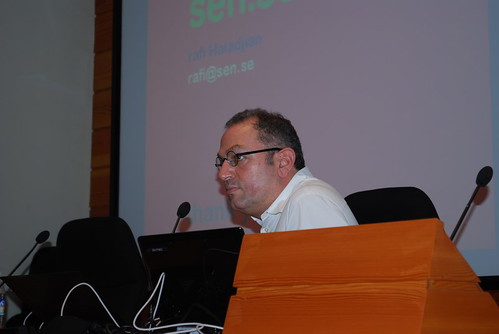
I have just found a pill of knowledge by David Rose, founder of Ambient Devices and now CEO of Vitality, the company that created the GlowCaps. It was a talk at Lift 09 on "Enchanted Objects - How fiction foreshadows innovation".
He describes his past work in Ambient Devices, from the early prototypes to the final designs, presenting the audience with some of the challenges and decisions they were facing. Liked it a lot!
Wednesday, March 3, 2010
Saturday, February 27, 2010
From the Internet of Things to the Internet of Hearts
Could you imagine all our hearts connected to the Internet?. Instantly and wirelessly transmitting our heartbeats to a central server, or maybe tweeting or pachubing? The first step has been taken through an innovative pacemaker that has been implanted to Carol Kasyjanski, becoming the first person to be monitored remotely.
Via: Network World
It is a tremendous convenience for the patient from even interacting with a telephone to call the doctor.
On a larger scale it enhances our ability to pick up and evaluate any problems with their pacemaker and certain other rhythm disorders that could be potentially dangerous or life threatening in ways we really could not do before.
Via: Network World
Wednesday, November 25, 2009
New books on the Internet of Things
A new book about the Internet of Things has been recently added to Scribd. The title says "Internet of Things. From RFID to Next-Generation Pervasive Networked Systems", and provides a good introduction to RFID-based solutions for IoT.
The only con is that it is too RFID-focused, scarcely mentioning the other side of the Internet of Things: embedded-connectivity mechanisms and protocols. In order to balance this aspect, a new book on 6LoWPAN (Amazon pre-order) "6LoWPAN: The Wireless Embedded Internet" is expected by the beginning of 2010:
Labels:
6lowpan,
books,
internet of things,
rfid
Saturday, November 21, 2009
And now... the tweeting house
After the tweeting plants, the tweeting home has arrived. It seems that the owner of the house, inventor Andy Stanford-Clarke, is using the Crossbow family of motes (maybe MicaZ from the images) to report tweets of information about windows, electricity meters and even... a mouse trap!
As so geek as this may seem, I am sure that we will witness in the next 2-3 years more and more things that tweet. In fact, Twitter has become a convenient communication channel for the Internet of Things: public information can be posted by objects, while other fellow followers may react accordingly. The only problem behind this is the limited amount of data in each tweet, moreover if some metadata has to be added in order to add structure or give meaning to he information.
Other alternatives may be provided by XMPP, the open protocol used by some Instant Messaging systems, which is also a good candidate to create dialogs between connected objects.
In the meantime, enjoy the video of the tweeting house:
Via: ReadWriteWeb.com
As so geek as this may seem, I am sure that we will witness in the next 2-3 years more and more things that tweet. In fact, Twitter has become a convenient communication channel for the Internet of Things: public information can be posted by objects, while other fellow followers may react accordingly. The only problem behind this is the limited amount of data in each tweet, moreover if some metadata has to be added in order to add structure or give meaning to he information.
Other alternatives may be provided by XMPP, the open protocol used by some Instant Messaging systems, which is also a good candidate to create dialogs between connected objects.
In the meantime, enjoy the video of the tweeting house:
Via: ReadWriteWeb.com
Thursday, November 5, 2009
RFID-enabled pet doors
You will never stop finding new uses of RFID. Check this: a pet door that automatically opens in the presence of your RFID-enabled pet (obviously with the RFID tag in the collar).
This application has 3 remarkable characteristics that makes it good to demonstrate the power of RFID in different environments:
Via: The RFID Weblog
This application has 3 remarkable characteristics that makes it good to demonstrate the power of RFID in different environments:
- The RFID tag is located in a mobile element (your dog, cat, crocodile, ...) that wanders around without any control, so it is a perfect scenario for tracking.
- There is one point of control, the door, where you want to allow the authorized pet to enter, and at the same time deny access to not authorized elements.
- Pet owners do have the need to use this device in order to avoid intrusions through the traditional pet door, so there is a clear need for this.
Via: The RFID Weblog
Thursday, October 29, 2009
Adam Greenfield vs El Mundo
It's not very common that a personality in the field of Ubiquitous Computing such as Adam Greenfield, that became widely popular with his book "Everyware: the dawning age of ubiquitous computing", appears in a Spanish mass media newspaper such as El Mundo. He was interviewed last Sunday as he took part in the Urban Labs meetings, organized by the citilab of Cornellà (Barcelona, Spain).
The interview from El Mundo quotes Adam saying:
It seems that Adam is not very happy with how the interview got its final form, and has created a blog entry in which completely rejects the result:what users ask has nothing to do with what they need
A request to my Spanish-speaking readers: please disregard utterly the interview with me that appears in today’s El Mundo of Spain. It’s almost impossible for me to discern anything resembling my own sentiments among its truncations, paraphrases, elisions and outright inventions.One of the few times, a Spanish newspaper focus on this area and they do it wrongly as to this extent....
Labels:
internet of things,
ubiquitous computing
Tuesday, October 27, 2009
Immaterials: the RFID aura
This video and experiment called Immaterials from Timo Arnall has become very popular between the Internet of Things and proximity interaction communities in the last weeks. It tries to decribe the interactive properties of RFID by visualizing the activation area of RFID readers and antennas with long-exposure photographs.
The results are not only aesthetically impressive, but a very good learning material in order to understand how RFID fields work.
Subscribe to:
Posts (Atom)