Friday, October 29, 2010

Starting up, new challenges and (maybe) a farewell

I titled this post like one of those book chapters that try to summarize the diverse happenings in a concrete timeframe. It's been some months since the last post, always having things to say and never finding how to do it.

Today it has been much easier.

It is the end of a long period (10 years) devoted to academic R&D and the start of a new professional life in my own (shared) start-up: Symplio.


I have been for some years now trying to figure out new ways of using the Internet through physical objects, sometimes called the "Internet of Things" (although for me there isn't a separate Internet for the Things, as there is no "Internet of People", just the Internet, ubiquitous and public like air).

Through Symplio we intend to bring to the world some new fresh product concepts as others did in the past and be part of the paradigm change produced by the merging of the Internet with the physical reality.

I don't know if I will ever continue writing on this blog, probably I will, but now I will try to focus on changing the world.

PS: my former research position as Smart Environments Research Leader is available and open for candidates. Find more info at MoreLab (position description is here).
Bookmark and Share

Tuesday, March 30, 2010

Architectures for the Internet of Things: Presentation at Web of Things 2010 (PerCom 2010)

I have just had my presentation at Web of Things 2010 (Percom 2010) where I explored the different architectures for the Internet of Things and analyzed them under certain key factors. In this way, an Internet of Things designer can have a small guidance about which architecture fits better for his/her project depending on:
  • where to place the intelligence (at the object or at the cloud)
  • the infrastructure required
  • the busines model flexibility
  • ...
In fact, the exploration of business models for the Internet of Things is a new topic of interest for me, a to-be-discovered world that resembles the Web in the mid-90s. My paper can be downloaded here and the slides are below.

Bookmark and Share

Tuesday, March 16, 2010

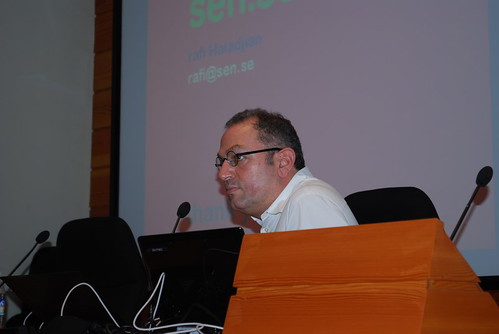
Rafi Haladjian at Deusto

Some weeks ago I invited Rafi Haladjian, founder of Violet, and now at sen.se to give a speech at the Spanish national RFID Conference we were hosting at Deusto. Talking with him was very "epiphanic" in the sense that he explained the process behind the conceptualization and marketing of Nabaztag, as well as the final situation where Violet was acquired by Mindscape.

Funny enough, I think that the current position of Rafi about the Internet of Things can be summarized in two sentences:

The problem with the Internet of Things are the things.

I don't know what the Internet of Things is... but it is not a rabbit.


Bookmark and Share

Wednesday, March 3, 2010

David Rose on "Enchanted Objects"

I have just found a pill of knowledge by David Rose, founder of Ambient Devices and now CEO of Vitality, the company that created the GlowCaps. It was a talk at Lift 09 on "Enchanted Objects - How fiction foreshadows innovation".

He describes his past work in Ambient Devices, from the early prototypes to the final designs, presenting the audience with some of the challenges and decisions they were facing. Liked it a lot!

Bookmark and Share

Saturday, February 27, 2010

From the Internet of Things to the Internet of Hearts

Could you imagine all our hearts connected to the Internet?. Instantly and wirelessly transmitting our heartbeats to a central server, or maybe tweeting or pachubing? The first step has been taken through an innovative pacemaker that has been implanted to Carol Kasyjanski, becoming the first person to be monitored remotely.
It is a tremendous convenience for the patient from even interacting with a telephone to call the doctor.
On a larger scale it enhances our ability to pick up and evaluate any problems with their pacemaker and certain other rhythm disorders that could be potentially dangerous or life threatening in ways we really could not do before.

Via: Network World
Bookmark and Share

Wednesday, November 25, 2009

New books on the Internet of Things

A new book about the Internet of Things has been recently added to Scribd. The title says "Internet of Things. From RFID to Next-Generation Pervasive Networked Systems", and provides a good introduction to RFID-based solutions for IoT.

The only con is that it is too RFID-focused, scarcely mentioning the other side of the Internet of Things: embedded-connectivity mechanisms and protocols. In order to balance this aspect, a new book on 6LoWPAN (Amazon pre-order) "6LoWPAN: The Wireless Embedded Internet" is expected by the beginning of 2010:

Bookmark and Share

Saturday, November 21, 2009

And now... the tweeting house

After the tweeting plants, the tweeting home has arrived. It seems that the owner of the house, inventor Andy Stanford-Clarke, is using the Crossbow family of motes (maybe MicaZ from the images) to report tweets of information about windows, electricity meters and even... a mouse trap!


As so geek as this may seem, I am sure that we will witness in the next 2-3 years more and more things that tweet. In fact, Twitter has become a convenient communication channel for the Internet of Things: public information can be posted by objects, while other fellow followers may react accordingly. The only problem behind this is the limited amount of data in each tweet, moreover if some metadata has to be added in order to add structure or give meaning to he information.

Other alternatives may be provided by XMPP, the open protocol used by some Instant Messaging systems, which is also a good candidate to create dialogs between connected objects

In the meantime, enjoy the video of the tweeting house:


Via: ReadWriteWeb.com
Bookmark and Share

Thursday, November 5, 2009

RFID-enabled pet doors

You will never stop finding new uses of RFID. Check this: a pet door that automatically opens in the presence of your RFID-enabled pet (obviously with the RFID tag in the collar).


This application has 3 remarkable characteristics that makes it good to demonstrate the power of RFID in different environments:
  1. The RFID tag is located in a mobile element (your dog, cat, crocodile, ...) that wanders around without any control, so it is a perfect scenario for tracking.
  2. There is one point of control, the door, where you want to allow the authorized pet to enter, and at the same time deny access to not authorized elements.
  3. Pet owners do have the need to use this device in order to avoid intrusions through the traditional pet door, so there is a clear need for this.
As fun as it may seem, this application exhibits very good reasons for being a success, at least for a number of people (a bit expensive, though, $797).

Via: The RFID Weblog
Bookmark and Share

Thursday, October 29, 2009

Adam Greenfield vs El Mundo

It's not very common that a personality in the field of Ubiquitous Computing such as Adam Greenfield, that became widely popular with his book "Everyware: the dawning age of ubiquitous computing", appears in a Spanish mass media newspaper such as El Mundo. He was interviewed last Sunday as he took part in the Urban Labs meetings, organized by the citilab of Cornellà (Barcelona, Spain).


The interview from El Mundo quotes Adam saying:
what users ask has nothing to do with what they need
It seems that Adam is not very happy with how the interview got its final form, and has created a blog entry in which completely rejects the result:
A request to my Spanish-speaking readers: please disregard utterly the interview with me that appears in today’s El Mundo of Spain. It’s almost impossible for me to discern anything resembling my own sentiments among its truncations, paraphrases, elisions and outright inventions.
One of the few times, a Spanish newspaper focus on this area and they do it wrongly as to this extent....
Bookmark and Share

Tuesday, October 27, 2009

Immaterials: the RFID aura

This video and experiment called Immaterials from Timo Arnall has become very popular between the Internet of Things and proximity interaction communities in the last weeks. It tries to decribe the interactive properties of RFID by visualizing the activation area of RFID readers and antennas with long-exposure photographs.


The results are not only aesthetically impressive, but a very good learning material in order to understand how RFID fields work.
Bookmark and Share

Friday, October 16, 2009

First International Workshop on the Web of Things (WoT 2010)


A successful approach to the Internet of Things is the so called Web of Things, a concept promoted by Vlad Trifa and Dominique Guinard that focus on the use of Web technologies, particularly RESTful services and mashups, to build the IoT.

The news is that they are organizing the First International Workshop on the Web of Things that will be held in conjunction with PerCom 2010 in Mannheim (Germany) from March 29th to April 2nd 2010. I guess some nice stuff and an enthusiastic community will come out from this event!
Bookmark and Share

Tuesday, October 13, 2009

My presentation on the Internet of Things at Tweakfest

Last month I was invited to Tweakfest to share my vision of the Internet of Things. It was a very exciting event with a nice mix of digital artists and technologists. Among the other invited speakers, I liked the presentations by Ian Pearson (futurologist!?) and Nam Do (co-founder of Emotiv Systems), who made a presentation of the EPOC.

For those of you interested, this was my presentation titled "Ambient Intelligence and the Internet of Things":


Bookmark and Share

Sunday, September 27, 2009

The Real-Time Web: a new candidate for Web 3.0?

The news website ReadWriteWeb.com is (too) strongly promoting a concept called Real-Time Web as the new "promised land" for all those who still think that there is a Web 3.0 after Web 2.0.

It is funny because I have seen how they have been generating a lot of buzz with this term, and how those news have been consistently linked from other websites. You may want a take a look at these two articles:
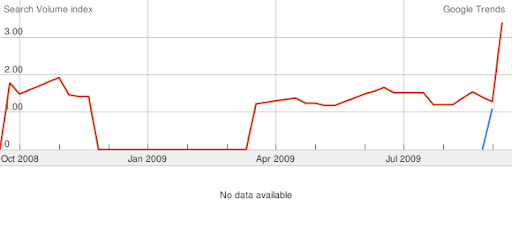
Now, let's look at this chart:

This is the evolution in terms of Google search of the terms "Internet of Things" (red line) and "Real-Time Web" (blue line) during the last 12 months. Two surprises:
  1. "Real-Time Web" started to be relevant at the end of August (about 1 month ago), where previously there was nothing. Probably it is because the promotion the guys from ReadWriteWeb.com are doing, in order to publicize their "ReadWrite Real-Time Web Summit", which brings me to the conclusion that on-line marketing, and the creation of "semi-artificial" concepts is at its best.
  2. The increase of the previous term is parallel with the raise of (my beloved) "Internet of Things". To which extent does that correspond to the fact that real world objects may be major actors in the Real-Time Web? (therefore, the term "Internet of Things" has also appeared in "Real-Time Web" articles).
My bet is that this sharp raise corresponds to the First International Workshop on the Web of Things (WoT 2010) to take place in Mannheim (Germany) in March 2010.

Finally, for those of you searching for Web 3.0, you may want to take a look at Web Squared...
Bookmark and Share

Tuesday, July 3, 2007

PhD finished! A thesis on Ambient Intelligence

Note: this entry is not new. It has been imported from my old blog and included here in order to have it as reference.
At last! Almost a month ago, on June 12th, I received my PhD degree after succesfully passing the PhD exam. The title of my dissertation was "A Reactive Behavioural Model for Context-Aware Semantic Devices".

For those of you interested, this is an excerpt from the abstract:

In this thesis, we propose a model for knowledge sharing between devices and for representing their behaviour in a way that promotes autonomous context-aware reactivity. In our approach, we bring Semantic Web technologies to the Ubiquitous Computing world in order to provide the means for collaboratively transforming data into knowledge and enabling intelligent reasoning mechanisms.

The model leads to a decentralised architecture where devices spontaneously discover each other, share context information, perform reasoning and adapt their behaviour dynamically in order to create a feel for Ambient Intelligence in the environment. In order to validate our approach we have identified some evaluation criteria and developed a number of prototypes that were deployed in experimental scenarios.

The results of our research may contribute to pave the way for a new wave of social digital objects that we denominate semantic devices.

The full version can be downloaded here:

Bookmark and Share